

In 1938, Neville Chamberlain famously met Hitler and returned claiming that he had won ‘peace for our time’.
But, in private, the two men had taken a dim view of one another.
Chamberlain described Hitler as ‘the commonest little dog . . . in a crowd, you would take him for the house painter he once was’. Hitler, meanwhile, chuckled that he had ‘manoeuvred this dried-up civilian into a corner’, and spent the evening with mistress Eva Braun, making jokes about Chamberlain’s oh-so-British umbrella. It didn’t bode well.

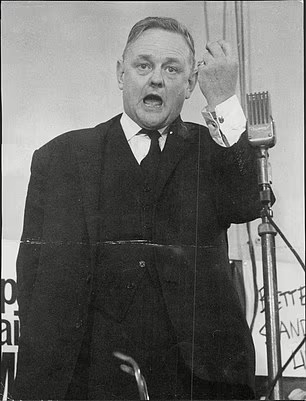
Quentin Hogg in later years
What has this slide into war to do with a student debate in 1933?
In February of that year, the Oxford University debating society, training ground for future politicians, heard the motion ‘That this House will in no circumstances fight for its King and Country’.
It was proposed by one Kenelm Digby, supported by such names as Michael Foot, later leader of the Labour Party in the 1980s, and the distinguished playwright Terence Rattigan.
This passionate peace lobby spoke about the recent horrors of the First World War, which had ended just 15 years earlier, and demanded much the same things as leftists today: a one-world government, a World State, an end to nations.
‘One money, one language, one peace,’ as one young idealist put it. Open borders, you might say.
M any believed, citing the example of Gandhi, that pacifist non-resistance would make it impossible for an invading army to use violence: a historically naive view, to put it mildly.
Speakers against the motion included Quintin Hogg, later Lord Chancellor, who warned the proposers, ‘Their policy is, in fact, a policy which would cause war.’
It was carried 275 to 153. The debate might have been dismissed as mere youthful rebellion.
But it caused uproar in a still highly patriotic Britain. Incensed letters poured into newspapers from the outraged Shires. They make glorious reading today:
‘Woozy-minded Communists . . . the practical jokers and sexual indeterminates of Oxford’; ‘sedition and treason’; ‘effete, effeminate, side-whispered, no good to God or man’. One commentator even said that these lefties ‘needed de-bagging’ i.e. having their trousers pulled down. Crikey!

There was also a delightful poem in Punch, praising Oxford’s silly students:
By your intellectual capers
Proving a godsend to the papers . . .
And universities in general as places
Where the unending human ass
Blows off at times superfluous gas . . .
All entertaining stuff, showing that little ever changes. But there’s a deeply serious point here: was Quintin Hogg right? Did this display of pacifism among our young elite only encourage our more belligerent enemies, and accelerate the coming of war? Absolutely, says the author, who offers abundant proof. He gives many examples of British travellers subsequently meeting eager young Nazis in Germany, who had all heard of the debate and regarded it as cheering evidence that Britain had no quarrel with the Nazis, no stomach for war, and would not intervene in Europe.
Hitler and Mussolini, Italy’s fascist dictator, knew about the debate too, and it emboldened them in their aggression.
Unlike Hitler, Mussolini spoke English, read our newspapers, and jubilantly described Britain as ‘a frightened, flabby old woman’.
In 1935, encouraged (rightly) in thinking that Britain would do nothing, he invaded Abyssinia (modern-day Ethiopia), a staggeringly brutal assault with mustard gas, tanks and the rest, resulting in the slaughter of at least 200,000 Ethiopians; some say half a million. The fascist way of war had truly arrived.
In 1936, the Spanish Civil War broke out, the Luftwaffe were called in to practise their bombing techniques on the population of the Basque town of Guernica in northern Spain, and the pacifist Oxford students began to look more and more foolish.
It is also a sombre fable about learning how the world and human nature really are, rather than what youthful idealism wishes them to be.
And when war finally came, the Lefties were the first in line, serving with distinction, and sometimes losing their lives in the process.
Michael Foot, unable to serve due to his chronic asthma, became a fiercely patriotic journalist and writer. Terence Rattigan joined the RAF and served on Sunderlands, flying dangerous 13-hour missions over the Atlantic, hunting submarines and then writing humorous letters home about being strafed by German fighters, ‘rather near me incidentally’, with the wry understatement of that unshowy generation.
And Kenelm Digby, original proposer of the Oxford motion, was in Borneo when the Japanese invaded in 1941, and spent three and half years in the dreadful Batu Lintang prison camp. He survived; two-thirds of the prisoners didn’t.
After his death, his widow confessed that ‘the Oxford Union motion haunted him; it dogged him wherever he went’.
Thus a single student debate became a historic event, and with all the usual tragedy and irony of history, a plea for peace contributed in some degree to conflict. The old Roman adage appears inevitably in the last chapter, as true now as ever: ‘If you want peace, prepare for war.’

