

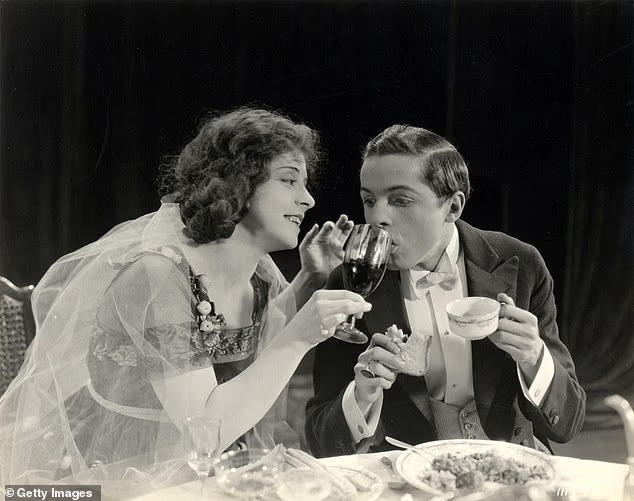
Noah, we learn in Genesis 9:20-21, ‘planted a vineyard: and he drank of the wine, and was drunken; and he was uncovered within his tent’. Things are still the same at Glastonbury. As this book repeatedly shows, wine has been an ever-present throughout human history.

Drink up: Since the 1970s, consumption of red wine in France has fallen by 90 per cent. We need to pull our fingers (and corks) out.
It’s partly because the stuff is so easy to make: you just squeeze some grapes. Soon the juice begins to bubble (that’s carbon dioxide coming out), and hey presto – your grape juice has fermented into wine. Our current best guess for the first time this was done is 8,000 years ago, in what’s now Georgia.
The oldest living vine is in Maribor in Slovenia, 400 years and counting, its red zametovka grapes still producing about 30 bottles a year. The vine even has its own anthem.
The great and the good have always had a taste for wine. Each member of the royal family in 5th century BC Persia was given five litres a day (that’s about six bottles). The leaders would debate each matter drunk, and then again sober – if the two decisions were the same they would act on it. As Kathleen Burk writes: ‘Is this in vino veritas being adopted as a judicial principle?’
The Mongol ruler Kublai Khan forced his ministers to keep drinking – any who couldn’t keep up were stripped of their ceremonial robes. George Washington drank a pint of madeira (fortified wine) with his dinner every day. Donald Trump, we note, is teetotal.

Drunk monk: In the 18th century it was a popular joke that when a bishop visited the Johannisberg priory in Germany ‘he could find no books, but that on asking for a corkscrew every monk produced one from beneath his habit’.
Religion, as Noah showed, has always loved a bit of vino. In the 18th century it was a popular joke that when a bishop visited the Johannisberg priory in Germany ‘he could find no books, but that on asking for a corkscrew every monk produced one from beneath his habit’.
Indeed the first ever patent for a corkscrew (1795) was filed by the Reverend Samuel Henshall of Oxford. A medieval manuscript records an abbot having drunk so much wine that ‘he cannot rise from his seat unless he be raised by both arms like a cow stuck in a muddy slough’. I know one thirsty vicar who was sacked after he started to recite the funeral service at a wedding.
Even war can’t stop us from drinking wine. General Joseph Joffre, commander-in-chief of the French forces on the western front in the First World War, thought that a quarter-litre (about a third of a bottle) was the ‘absolute minimum that a soldier should drink each day to maintain his well-being’.
That was early in the conflict – by 1918 the ration was up to three quarters of a litre. In 1982, when Israeli and Syrian tanks faced each other across 200 acres of vineyards, the grape pickers continued to do their job, crawling between the vines while ammunition flew over their heads.
Given that wine brings so much pleasure to so many people, it’s no surprise that some want to ban it. One particularly tedious organisation in the 1880s was called the New Zealand Alliance for the Suppression and Abolition of the Liquor Trade.
Eventually the country introduced a law forcing all bars to close at 6pm. Needless to say this led to the ‘six o’clock swill’, in which people necked as much as they could after work and before closing time. It wasn’t until 1967 that licensed hours were extended until 10pm.

Inspiration: ‘Bacchus’, c1597. Bacchus, Roman god of wine (Dionysius in the Greek pantheon), seated as at a banquet, with a wreath of vine leaves, holding a drinking vessel
But of course the most famous experiment in prohibition was America’s, lasting from 1920 to 1933. During that period the Library of Congress kept its books on wine in the ‘indecent books’ section.
One farm in California had its wine thrown away by federal agents, 140,000 gallons forming a lake three feet deep ‘from which the men and boys of the small farming community drank deeply all day’. There was an exemption if the alcohol was for medical purposes, which is why the Paul Masson company rebranded their sparkling wine as ‘Medicinal Champagne’.
Burk’s research is the definition of ‘exhaustive’. Just one of the books she consulted was a five-volume study of the grape varieties grown in Bulgaria, all 1,350 of them.
By detailing which grapes and production methods were introduced by which empires to which territories, she covers most of the political headlines of the last few millennia. After Romania abandoned communism in 1989, and winemakers went there to offer advice, it proved difficult to find good workers: ‘Under communism, people just had to turn up to their jobs and the ones who actually worked were seen as the losers.’
Recent decades have seen a decline in wine-drinking in all major European countries. Particularly staggering is that since the 1970s, consumption of red wine in France has fallen by 90 per cent. We need to pull our fingers (and corks) out.
We should remember the Hittite king Suppiluliuma, who died in 1322BC. On his tomb was inscribed the advice: ‘eat, drink and be merry’.

