

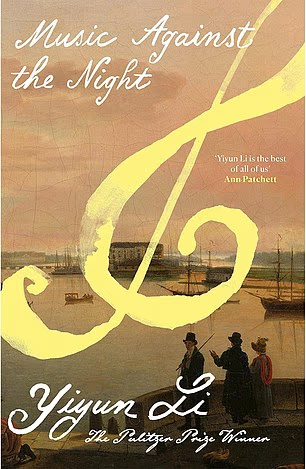

Music Against the Night is available now from the Mail Bookshop
Music Against the Night by Yiyun Li (Fourth Estate £20, 352pp)
Few now remember the Irish composer John Field, although he invented the nocturne form for piano that Chopin would make famous.
He died before he could fully realise his talent, and this theme – of lives squandered or prematurely cut off – hums through this unusual novel like a minor key melody.
Li – whose own experiences provide a deeper painful haunting – counterpoints Field’s heavily pressurised upbringing with that of his eventual wife, Adelaide Percheron, herself an exceptionally gifted yet untrained pianist, in a novel that is always sharply aware of the vagaries of fate.
As a historical account of two forgotten geniuses, it’s a tad clumsy. As a meditation on the question of who we remember, and which lives fall by the wayside, particularly those of dead children, it dazzles.
‘What did it signify, to be remembered?,’ thinks Adelaide, on hearing of her husband’s death. ‘When a life ends, night falls. All the daybreaks hence belong to others.’
American Hagwon by Min Jin Lee (Fourth Estate £25, 656pp)
If Western readers want to know more about the modern experience of the Korean diaspora, Jin Lee’s novels are a good place to start.
The third in a planned quartet, this is primarily the story of the Koh family (although at 600-plus pages long, it contains a lot of characters) – a hard- working bunch newly arrived in Seoul after time in Australia and whose lives revolve round the economies and principles of education.
Hagwons are crammer schools for Korean children and much of the novel concerns the lifelong impact of one school in particular on the three ambitious conscientious Koh children.
Lee pumps her novel with a lot of old-fashioned detail on how society actually works on a purely economical level, but her cast of characters offer plenty of compensatory pleasures.

The Mystery of What Befell in the Ditch is available now from the Mail Bookshop
The Mystery of What Befell In the Ditch by Thure Erik Lund (And Other Stories £14.99, 240pp)
Top marks to those who manage to get through this very tricky novel – considered a classic in its native Norway but also regarded as untranslatable – until now.
It’s the story of Tomas Olsen Myrbråten, who has retreated into the wilderness following a scandal and embarks on a profound recalibration of his place in society, his relationship to language and on the meaning of the self.
Everything pretty much breaks down, including language and meaning, in this quite mad novel, which will either give you a nervous breakdown, bore you senseless or leave you exhilarated by the possibilities of the form.
I found myself experiencing a bit of all three.

