

- Togetherness Rowan Hooper Fern Press £25, 416pp
If it wasn’t for symbiosis,’ biologist Rowan Hooper writes in his new book, our planet would be ‘nothing but slime.’ Symbiosis, in the simplest definition, is co-operation between different species, and life hasn’t proliferated over billions of years because of competition but through that very co-operation. To many, this idea seems to go against all we know of evolution. Certainly, Darwin emphasised the role of competition.

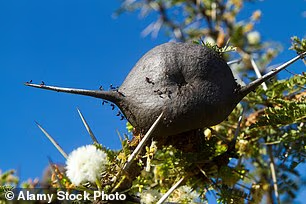
The Whistling Thorn Tree is protected by ants
Nonetheless, as Hooper points out, Darwin also knew, of course, that ‘Life… depends on other life’. Plants and animals ‘are bound together by a web of complex relations’.
Today that web is even more apparent and Hooper provides us with examples.
What he calls the ‘simplest example of symbiosis’ can be seen by pulling up any legume (beans, etc) and noting little white balls on their roots. These nodules are grown in partnership with bacteria called rhizobia, which extract nitrogen from the air and turn it into fertiliser. Without rhizobia, the plants wouldn’t be able to grow.
In Tanzania, Hooper witnesses the symbiotic relationship between the whistling-thorn tree and a species of ant. In return for the tree’s nectar and shelter, the ants will attack any herbivores – even elephants – that try feeding from the tree. When Hooper touches the tree, ants immediately swarm over his hand, biting him.
Closer to home, we humans are living embodiments of symbiosis (‘mobile ecosystems’ in Hooper’s words). Trillions of organisms live on and in our bodies, which ‘change who you are and what it means to be you’. Serotonin is a compound that influences our moods. Up to 95 per cent of it is created by symbiotic microbes in our guts. Hooper quotes the authors of a 2017 book entitled The Psychobiotic Revolution: ‘Your greatest joys to your darkest angst turn out to be related to the bacteria in your gut.’
In Togetherness, Hooper proves an eloquent advocate for his ideas. Symbiosis, he argues, ‘is fundamental to how life began, how it evolved, and how it operates’.
The assumption that competition alone ‘powers the world’ has ‘brought us to the brink of ecosystem collapse’. We need to recognise the ways in which ‘life grows in connection with other life’.

