

New footage has revealed the shocking impact our litter is having on nature.
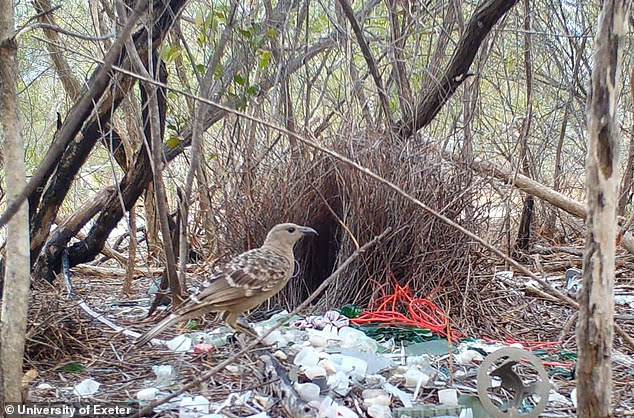
Researchers from the University of Exeter say bowerbirds in Australian cities are using human items to impress their mates.
Male bowerbirds create intricate tunnels called bowers in the hopes of dazzling females.
While bowers are mostly made from twigs, the birds are also now including colourful items – mostly from human sources.
Photos and videos shared by the researchers show bowers featuring everything from medicine jars to plastic mouth guards, and even toy handcuffs.
Worryingly, the long–term impact of these items on the birds remains unclear.
Dr Laura Kelley, an author of the study, said: ‘Our study demonstrates that availability of human items – often glass and plastic – is affecting the behaviour of bowerbirds.
‘We don’t yet know whether this has any negative or positive impact on them, but it’s a reminder of how human activity is changing the natural world in unanticipated ways.’

Researchers from the University of Exeter say bowerbirds in Australian cities are using human items to impress their mates


Male bowerbirds create intricate tunnels called bowers in the hopes of dazzling females
Bowerbirds are found throughout Australia and New Guinea, and are known for the elaborate structures that males build to woo females.
‘Bowers are built exclusively to attract a mate, and males choose decorations that contrast against their own plumage and the bower itself,’ said Caitlin Evans, an author of the study.
‘Once a female arrives and stands in the bower, males throw an object into their view and then display the plumage on the back of their head, then throw another object – and so on.’
In the study, the team compared items collected by bowerbirds in Townsville City and a rural area, both in Queensland, Australia.
Their analysis revealed that birds living in the city gathered larger, more colourful decorations than those in the countryside.
They also collected more items – about 90 on average, compared to 20 for rural birds.
Ms Evans said: ‘Our findings show that bowerbirds in a city use a wide range of items scavenged from humans.
‘Glass, plastic and wire were common choices, but we also found items including a pair of handcuffs, medicine jars at bowers near a hospital, and fluorescent mouth guards from a site near an Australian Rules football ground.’

Bowerbirds are found throughout Australia and New Guinea, and are known for the elaborate structures that males build to woo females

Birds living in the city gathered larger, more colourful decorations than those in the countryside
In the city, the birds were found to collect more vivid red decorations, and duller green items.
The researchers speculate this could be to do with the female birds’ vision.
Ms Evans explained: ‘Our study did not assess whether females favour the more striking items collected in urban areas, but the males’ enthusiasm for gathering these items suggests this is likely.’
As for where the birds are finding the items, the researchers suggest that rural birds are visiting farms.
Ms Evans added: ‘Even in rural areas, birds find items made by humans. In this case, we think they raid the bins and garage of a farm – and also the bowers of other male bowerbirds.’
In a second part of the study, the researchers collected 20 items – 10 from an urban bower and 10 from a rural one.
They presented these to both urban and rural males, and both groups strongly favoured human–made items.
Overall, the findings suggest that the availability of human items is affecting the behaviour of bowerbirds.
What this means for the species long term, however, remains unclear.

