

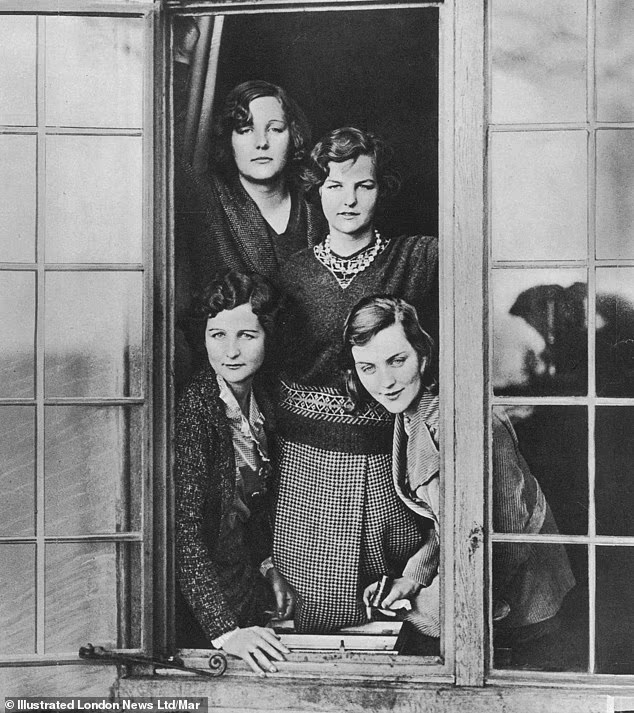
A rum lot, the Mitfords. Head of the clan, Lord Redesdale, was chairman of the House of Lords’ Drains Committee and kept a pet mongoose.
He thought formal education would ‘thicken his daughters’ ankles’, so none of them had a day’s schooling. Lady Redesdale, in her turn, distrusted doctors and poured medicines down the sink.
She also disagreed with the idea of refrigerators. Her laundry was sent to Harrods.

Crusade: Jessica (standing, right) with (clockwise from top left) sisters Unity, Diana and Nancy
As regards the children of what Carla Kaplan calls ‘one of the oddest families in England’, Nancy became a novelist and biographer in Paris, dressed by Dior. Her subject was the vanished glory of aristocracy. The Pursuit Of Love and Love In A Cold Climate remain popular, as does The Sun King: Louis XIV At Versailles.
Pamela, to whom John Betjeman proposed twice, went to live in an Irish castle with a female showjumper.
Diana was an unrepentant fascist. When she married Oswald Mosley, Hitler, whom she believed was ‘the kindest man in the world’, came to the wedding. Joseph Goebbels hosted the reception.
Unity was even more of a Nazi enthusiast. Deciding to live in Germany, she went to the Nuremberg rallies and applauded wildly.
Disappointed the Nazis and Britain had failed to form an alliance, when war was declared she shot herself in the head with a small pistol inlaid with mother of pearl.
After her suicide attempt failed, Hitler organised for her to be treated in neutral Switzerland. He paid her medical bills and arranged transport for her, and her family, all the way to Folkestone. Unity lingered until 1948, when she died of meningitis in Oban, Scotland, near where the Mitfords owned a Hebridean island.
Youngest sister Deborah, or Debo, became the Duchess of Devonshire, living at Chatsworth. It is Kaplan’s contention she had a long affair with President John F. Kennedy. The evidence looks convincing.

Decca eloped with Esmond Romilly, Winston Churchill’s nephew, when she was just 17
But it was Jessica, known as Decca, who decided to set herself against ‘everything the family stood for’, and who, we are told, ‘broke rules, raised hackles, caused offence, and took huge chances’. If Diana and Unity brandished swastikas, on Decca’s wall was a poster of Soviet communist leader Lenin. She was the Mitford’s Red Sheep.
If that all sounds like a recipe for irresponsibility, Kaplan is quick to argue that Decca spent her life ‘fighting for justice, exposing corruption, trusting in facts, forging ahead’. Her background made her the most unflappable of activists.
Her first cause was the Spanish Civil War. Aged 17, she eloped with Esmond Romilly, her second cousin and Churchill’s nephew, who said ‘the only thing to do with the English upper class is to marry into it’. Romilly and Decca were duly married in May 1937.
In Spain, ‘as defectors from their class, Decca and Esmond were instant celebrities’.
Decca, in a uniform of brown corduroy, charged to Lord Redesdale’s account at the Army and Navy Stores, fired at the enemy, but hit a tree. That was to be the extent of Decca’s experience of combat.
Seven months after marrying, the couple had a daughter, Julia, who died of measles – a tragedy Decca never mentioned in her memoirs, as ‘the deeper the hurt, the less Decca would speak of it’.
Possibly to recover and distract themselves, in 1939 she and Romilly emigrated to America, where two years later they had another daughter, Constancia.
Decca worked in a shop, selling costume jewellery in Miami. She failed to find superior employment because, under ‘colour’ on application forms, she put ‘light brown’, thinking hair was meant, not skin and race. Romilly, meanwhile, gave talks to luncheon clubs on ‘Sex Life at Oxford University’.
Once initial high spirits wore off, the union faltered. Decca and Romilly were ‘getting on one another’s nerves’. Romilly, indeed, was ‘dogged by boredom’ until he joined the air force as a navigator. He was killed in action in November 1941, aged 23, leaving Decca a sizeable inheritance. ‘She didn’t say much about the irony of being a Communist’ benefiting from the proceeds and dividends of capitalism.
During the war years, Decca obtained a secretarial job at the British Embassy in Washington, where she discovered a ‘knack for rigorous undercover research’.
Described by Kaplan in almost Hollywood terms as a ‘dark-haired, blue-eyed, vibrant beauty with a steely gaze and a dazzling smile’, Decca enjoyed the fine-toothcomb toil at the Office of Price Administration, pursuing black marketeers, profiteering businessmen, and anyone suspected of unfair trade.
In 1943, she married progressive lawyer Bob Treuhaft, whose firm, Gladstein, Grossman, Sawyer and Edises, was known to Decca as Gallstones, Gruesome, Sewer and Odious. Her sisters deplored her association with all these Jews. The same year, Decca officially joined the Communist Party, becoming financial director of the San Francisco branch.
The organisation apparently provided ‘a powerful sense of optimism and hope’, and Decca reluctantly resigned when information about Stalin’s atrocities started to become widespread.

Decca spent much of her life living and working in America where she not only published books and aided her husband at his law firm, but also was heavily involved with the Communist party and wider activism
Decca helped Bob research his cases, filling her days with prison visits, death row and rape appeals, civil rights battles, and fundraising drives. Seeing inequality, corruption and cruelty everywhere, Decca chanced upon her greatest subject, the funeral industry.
She was appalled at the way undertakers were preying on vulnerable families, overcharging and deceiving grieving clients. One widow was told that to fit her husband into a cheaper coffin, his feet would be chopped off.
Published in 1963, The American Way Of Death was a bestseller due to the mixture of black comedy and fascinatingly gory detail, such as the way ‘the mouth is sewn shut with a needle directed upward between the lip and gum and brought out through the left nostril’.
Decca evidently had huge fun researching shrouds, burial negligees, ‘brunch coats for corpses’, and devices that make ‘breasts look perky’. At vast cost, the dead are made to seem still alive.
The book made Decca a media personality, with lecture tours and teaching engagements – her topic was investigative journalism. Apart from in her jaunty memoir, Hons And Rebels, about the Mitfords, she never again caught the popular imagination.
Despite large advances and a reputation as ‘queen of the muckrakers’, subsequent publications lacked sparkle.
There was a puritanical, obsessive streak in Decca, and I suspect she was a frightful busybody. Ticking people off came naturally to her – she’d get on her high horse about, say, the invention and sale of apricot-scented tissues, baby food, slimming products or hair dyes.
Driven to expose vanity and money making, Decca was like one of those aristocrats – Maggie Smith’s Lady Grantham in Downton Abbey, for instance – who, propped up by inherited wealth, deplore pretension as common and the need to earn a living as middle-class.
Decca was proudly useless at domesticity. ‘No one had ever explained to me that you had to pay for electricity,’ she admitted. She’d travel with 13 pieces of luggage, as if a band of servants would materialise to take charge – and she liked getting others to pack and carry her bags.
Kaplan shows that, once a Mitford, always a Mitford. Decca died of cancer in 1996, aged 78.

