

- Hyperscale by Paris Marx (Profile Books £22, 320pp) is available now from the Mail Bookshop
I think that it’s fairly likely,’ a man named Ilya Sutskever once told a journalist, ‘that it will not take too long of a time for the entire surface of the Earth to become covered with data centres and power stations.’
Sutskever was a co-founder of the firm OpenAI and he thinks this is the future. Possibly even a good thing. His remains an extreme view but, as Paris Marx points out in this urgent polemic against the power of Big Tech, the number and size of data centres are today growing exponentially.

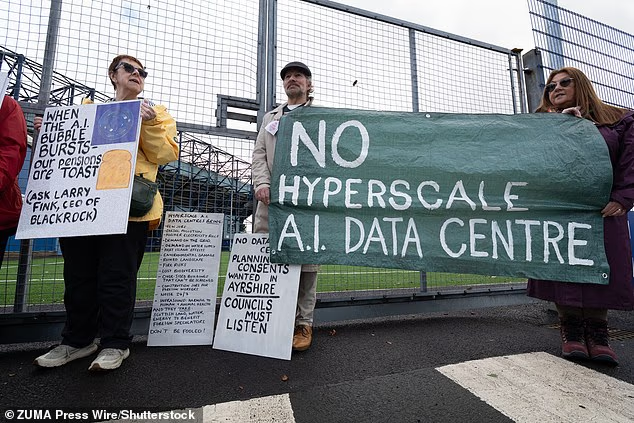
Protest: The Reject Hunterston Data Centre Campaign Group and Hurlford Rufus Data Centre Community Group held a protest outside a B2B business event in Kilmarnock, 2026
This was not seen as a particular problem until recently. Largely because many of us didn’t even realise they existed. What exactly are they? In Marx’s words, they are the ‘vital organs of the digital age’. They are vast buildings that house the computers needed
to keep the internet going. Hyperscale data centres are huge clusters of them.
All the major tech companies – Google, Amazon, Meta – are falling over themselves to build them. Getting the truth about them is not easy. The big firms hide behind NDAs (non-disclosure agreements) and shell companies. When Google created its first purpose-built data centre in Oregon, one journalist
said obtaining information about it was ‘almost as difficult as finding Bigfoot’.
Data centres store enormous amounts of data. One estimate suggests that within the next couple of years, 291 trillion gigabytes of digital data will be generated every single day. Much of it will continue to be stored regardless of how useful it might or might not be. This all has consequences in the real world, where we mostly still live.
Data centres eat up power. One hyperscale data centre cluster is, in Marx’s words, ‘effectively making the same demands on the grid as everyone living in a large city’. Computers need to be kept from overheating, and this involves very large quantities of water. The tech companies have become ‘water vampires’. They suck the cities surrounding them dry.
Google had plans for a data centre in Cerrillos, Chile, which in a year would consume as much water as the 80,000 residents do for drinking water. The impact of the ravenous demand for energy and water on climate change is clear. Companies may flaunt eco-credentials in their PR but their actions belie them.
Paris Marx has produced a passionate, well-argued case for action against the unregulated expansion that Big Tech is already imposing on us. For too long, he argues, ‘we’ve sat back and allowed the billionaires of Silicon Valley to chart our collective future’. The danger is clear. ‘If we don’t take back the wheel soon, there may not be a future left to chart.’

