

Speaking and communication skills will get equal status with reading and writing as part of an overhaul of the national curriculum by Lucy Powell.
The Education Secretary announced today that the ability to speak confidently will be ‘hardwired’ into a revised national curriculum and assessed as part of GCSE exams.
In addition, she plans to reduce the amount of academic writing in subjects such as music, PE and drama, instead adopting more ‘practical’ modes of assessment.
However, critics fear her plans will reverse Tory reforms to ‘toughen up’ the curriculum, despite a Labour review last year concluding that many of the changes should stay.
Laura Trott, shadow education secretary, said: ‘Lucy Powell seems to be tearing up the last two years as if they never happened, with a constant change of direction.
‘Blowing open the curriculum and assessment review once again creates more confusion for schools and risks reopening the hard-won debate over the importance of a knowledge-rich curriculum.’
The move signals a change from the ideas of her predecessor, Bridget Phillipson, who argued for smaller changes to teaching.
Ms Phillipson’s landmark curriculum review, led by Professor Becky Francis, found that much of the content should remain unchanged.
It comes after the latest international tests run by the Organisation for Economic Co-operation and Development showed England shooting up world league tables following the Tories’ reforms.

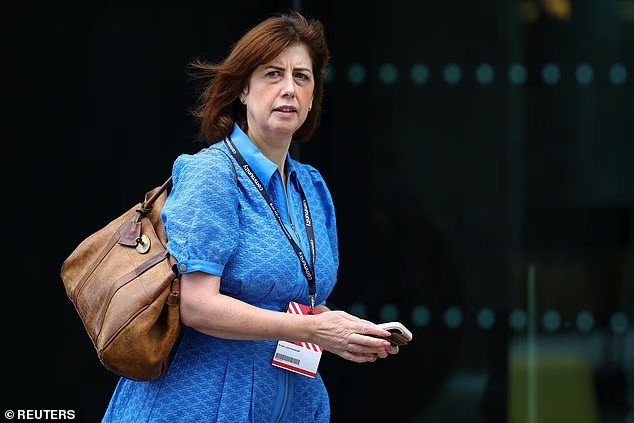
Speaking and communication skills will get equal status with reading and writing as part of an overhaul of the national curriculum by Lucy Powell (pictured)
In a speech to school leaders today, Ms Powell argued that ‘practical skills are disappearing from practical subjects, just when the world demands the opposite.’
She added: ‘That isn’t politics or ideology; it’s a fact.’
She also said that, with the rise of artificial intelligence, the ability of young people to communicate in person will become far more important – something state schools have tended not to prioritise.
Addressing the Confederation of School Trusts (CST) annual conference in Birmingham, she said: ‘With AI on the rise, we need to go harder on the skills that makes us human, like oracy.
‘That ability to articulate yourself confidently is central to success in work and in life, but for too long it’s been a marker of privilege.
‘Now it will become the right of every child – nobody left out because they can’t speak up. That’s why we’re hardwiring oracy into the revised National Curriculum.
‘And I can announce today that I will give oracy equal status to reading and writing, as a new strand of the English curriculum.’
She said Labour would work with schools and the exams regulator Ofqual to ensure ‘oracy will light up every classroom’.
‘Both in content and in assessment, speaking, listening and communicating will be a core part of every child’s education, from primary to GCSE and beyond,’ she added.
‘And that is the oldest form of connection we can think of, building relationships by communicating.’
Government sources claimed Ms Powell would not rip up the Francis review.
As part of the overhaul, Ms Powell has already announced she wants new vocational GCSEs to sit beside academic ones.
Previously, Ms Phillipson was keen to ensure more teenagers could take art, music or drama at GCSE while retaining some pressure on them to choose humanities and languages as well.
A senior education source told The Times the announcements from Ms Powell were ‘vibes’, retrogressive and light on detail.
However, a source close to Powell said: ‘If we are serious about improving young people’s life chances, we need an education system that reaches beyond the classroom to ensure every young person leaves school ready to thrive in further study, work and life.’

