

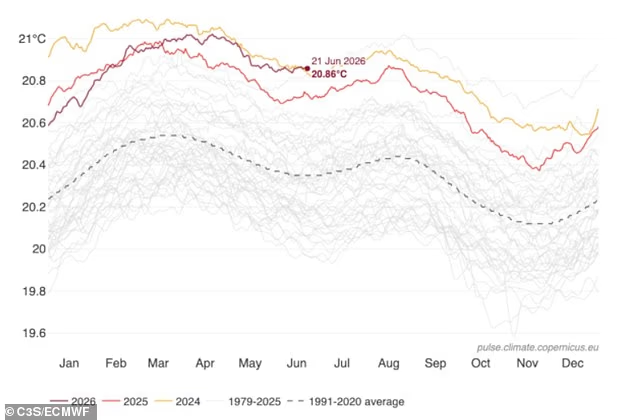
The planet’s oceans are at unprecedented temperatures for this time of year, scientists have warned.
Experts from the Copernicus Climate Change Service revealed that last month, temperatures outside the polar regions hit an average of 20.86°C.
This marks a new record for June, exceeding the extraordinary highs recorded in 2023 and 2024 – which at the time scientists said were ‘terrifying’.
Now, they have said the new peak will likely bring ‘consequences for weather patterns, global climate and marine ecosystems’.
It comes amid concerns that a ‘super El Niño’, which could bring extreme heat ‘almost everywhere’ across the globe, has begun.
NASA satellites recently confirmed that the weather phenomenon – characterised by warmer water in the equatorial Pacific – is ‘underway’.
‘Current conditions could indicate the beginning of a new phase, leading, once more, to uncharted territory,’ Carlo Buontempo, Copernicus Climate Change Service Director, said.
‘With ocean temperatures at these levels and El Niño on the horizon, we are likely to see more temperature records fall in the coming months.’

Experts from the Copernicus Climate Change Service revealed that last month, temperatures outside the polar regions hit an average of 20.86°C

Parts of Europe are in the grips of a marine heatwave that is bringing sea temperatures up to 6°C higher than average

The Super El Niño is ‘underway’, NASA has confirmed, following satellite observations of sea surface height across the Pacific
Over the past three years, the global ocean outside the polar regions has been between 0.35°C and 0.73°C warmer than the long-term average.
The last June record, set in 2024, stood at 20.83°C – with the new record now just above it.
Experts warned that a warmer ocean has wide-ranging impacts.
Higher ocean temperatures keep the atmosphere warm for longer, provide extra energy to storms and increase evaporation – enhancing the potential for extreme precipitation and flooding.
Warmer seas also contribute to sea level rise and ice melt, and stress marine ecosystems. They also keep the air warmer, fuelling heat waves.
Commenting on the new record Professor Simon Tett, Chair in Earth System Dynamics at the University of Edinburgh, said: ‘This is not a surprise.
‘Atmospheric CO2 keeps increasing as fossil fuel is burnt. More CO2 means more heat trapping, which shows up as higher ocean temperatures.
‘On top of this human-driven warming, there is likely a bump from the El Niño which has started to warm the Eastern Pacific.’
A startling image, released earlier this week, showed parts of Europe in the grips of a marine heatwave with some areas recording temperatures 6°C higher than usual.
The worst-hit areas were in the western Mediterranean Sea, particularly in the Gulf of Lion off the coast of southern France, and in the Ligurian and Tyrrhenian seas along the western coast of Italy.
Last month, the UK and many other countries in Europe sweltered amid new heat records while Antarctica experienced unprecedentedly balmy winter conditions.
And according to forecast models, this could only get worse – as the strength of this year’s El Niño is likely to reach levels not seen in decades.
Experts predict the phenomenon will have ‘widespread effects’ including bringing wetter conditions to the American Southwest and drought to countries in the western Pacific.
While its influence on British weather is indirect, a particularly strong El Niño event could raise global temperatures and supercharge the heating effects of climate change.
Simon Culling, a prominent data collector and investigator for the UK’s Tornado & Storm Research Organisation (TORRO), wrote on X: ‘If the current predictions for the forthcoming El Niño phase are realised, what does this mean for the UK?
‘It may mean hotter summers for both 2026 and 2027 and increases the risk of a significant cold spell in winter 2026/27. Let’s see what plays out.’
Meteorologists say El Niño’s intensity will likely be comparable to the 1997/98 event which saw global temperatures reach their highest on record.
During its development, the UK experienced an exceptionally hot, sunny and humid August characterised by heatwaves.
Speaking on the possible development of El Niño, Grahame Madge, a climate science communicator at Met Office, previously said: ‘This is likely to be a significant event.
‘It’s likely to be the strongest El Niño event so far this century. And we’re probably comparing it to the 1998 one. This was a significant year for global temperature and at the time, it was the warmest year on record.’

