

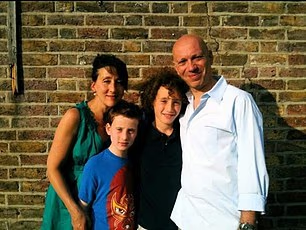
In the early hours of November 29, 2019, Zac Brettler, a public schoolboy from north London, fell mysteriously to his death from the fifth-floor balcony of a luxury apartment block on the Thames.
The coroner recorded an open verdict, and while no one can know for sure what was going through the teenager’s mind, Patrick Radden Keefe’s painstaking investigation into the case builds a terrifying picture of the weeks that led the 19-year-old to a point of no return.

The Brettler’s with Zac second from left
A celebrated investigative reporter, Keefe convincingly lays out evidence to suggest that Zac jumped not to kill himself, but to save his own skin after a wildly out-of-control fantasy life left him cornered in a dangerous underworld governed by greed and violence.
Zac, we learn, had a happy childhood but soured in his teenage years, but turned on his parents – a journalist and a banker – after he failed the entry requirements for Harrow, the school of his dreams. Confronted by increasingly alarming behaviour – he put his hands around his mother’s throat during an argument – his parents surreptitiously tested his blood for drugs, rigging up a hidden camera to spy on his movements when he was home alone.
There was no evidence of substance abuse – and the camera footage showed nothing more than Zac watching TV with his tennis club pals.
Yet the Brettlers knew something was up.
He had become obsessed with oligarchs, mixing with their children at boarding school, where they thought nothing of calling an Uber to spare themselves the eight-minute walk to class from their dormitory.
Zac grew particularly fixated on Roman Abramovich, then owner of Chelsea Football Club, whose glitzy lifestyle he seemed to envy. Fancying himself a wheeler-dealer, he dreamed up money-making schemes, selling cigarettes in class and trainers online.
At a charity auction in 2019, he got chatting to a property manager named Mark Foley – who by amazing coincidence worked for Chelsea.
Foley introduced Zac to a notorious entrepreneur named Akbar Shamji, the son of a Tory donor who had fled Idi Amin’s Uganda.
Working with Shamji on international business deals, Zac swiftly amassed a bank balance of nearly £1 million – or so he told his parents.

Obsessed: billionaire oligarch Roman Abramovich
Remarkably, they took him at his word, seemingly caught between extreme suspicion and an equally understandable desire not to squash their son as he tried to make his way in the world.
Yet Zac was in grave danger.
The morning before he died, he told his mum he was looking forward to spending a relaxed weekend chilling out with a friend.
L ater that evening, after noticing her son had left his credit cards and beloved Moncler gilet at home, she messaged to check he was OK.
A reply came at 2.03am: ‘All good x’.
Twenty minutes later Zac had fallen to his death.
Reporting him missing to police in the morning, Zac’s parents met Shamji, who told them that he had left Zac alone at the riverside flat of his business associate Verinder Sharma.
Sharma took a sleeping pill before bed; in the morning, Zac was gone.
The story didn’t add up – and neither did the blindsiding revelation that his new friends knew him not as Zac Brettler but as Zac Ismailov, heir to a recently deceased Russian oligarch worth £205 million.
Zac apparently told Shamji he had been kicked out by his widowed Swiss mum over a row about how to dispose of the fortune.
Believing the lie, Shamji introduced him to Verinder Sharma, who was all too ready to give shelter to a young man with money to burn.
Convicted of forgery at 23, Sharma was a career gangster, says Keefe, describing a past kidnapping in which he slit the victim’s throat, jamming his fingers into the wound.
The Brettlers knew none of that when Zac went missing.
Nor did they know Verinder Sharma had paid a maid service to clean his flat before police could search it.
Zac’s body, found by a commuter crossing Vauxhall Bridge, wasn’t identified for four days.
Keefe assembles a wealth of evidence to suggest that the teenager died in the wake of Sharma’s fury over his deception.
T he tale is terrifying and impossibly tangled.
Everyone involved let themselves believe what they wanted to be true.
Zac’s parents, keen for him to thrive, seem to have been oddly incurious about his improbable entrepreneurial precocity.
Meanwhile, his dodgy business associates were so hungry for cash that they checked nothing, even falling for Zac’s ‘thick Russian accent’.
But the subterfuge was deadlier than he could have known.
Shamji, a serial chancer with a litany of failed ventures in his wake, had just declared himself bankrupt when he and Zac crossed paths – and Sharma was a lifelong thug eyeing a pre-retirement payday.
Trapped alone with this ex-boxer who was a veteran of punishment beatings, Zac jumped, hitting an embankment on his way down.
That, at any rate, is the narrative persuasively laid out here.
Sharma died of an overdose a year later.
Akbar Shamji, seen on CCTV examining the river where Zac fell, wasn’t prosecuted as the Metropolitan Police ignored witnesses and evidence. The Brettlers were denied a Victims’ Right to Review of the case on the grounds that ‘they were not victims’.
Keefe put his services at their disposal after learning that his family and Zac’s were connected through Zac’s rabbi.
His superhuman capacity for legwork produces a gripping narrative layered with twists and thunderclap cliffhangers.
The book isn’t just about Zac’s death, but the proximity of London’s glittering wealth to its sordid underbelly.
It’s also about a family’s irreparable fracture.
Why was Zac posing as an oligarch’s son in the first place?
Keefe links it – a little neatly – to his childhood gift for telling stories.
Yet if his schoolfriends could see through his tales of hobnobbing with Nigerian royals and Russian models, why couldn’t his parents?
I won’t be the only parent reading with a shudder. There but for the grace of God, you might think.
The Brettlers’ ignorance of their son’s tortured double life is the inescapable agony at the heart of London Falling.
Keefe agonisingly conveys the sense of Zac’s turbulent adolescence as a runaway train, his parents its powerless passengers.
‘He should have been an actor. He should have been a writer. He should be something,’ says Zac’s mother. ‘He shouldn’t be a dead boy of 19.’

