

One spring afternoon in 2009, on a tour of the childhood homes of Paul McCartney and John Lennon, a few people noticed something faintly familiar about another member of their group.
He had a wizened face, partly hidden by a hoodie, and a pencil moustache. As it turned out, it was Bob Dylan, who had coughed up £16 so he could quietly visit these shrines to his two old friends.

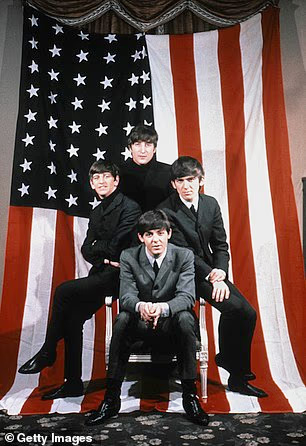
The Beatles in America in 1964
In Lennon’s bedroom, he was intrigued by a Just William book. ‘Hey man,’ the rocker demanded. ‘Who’s that Just William dude?’
It was the strangest thing, the tour guide recalled, to be explaining to Bob Dylan the appeal of Richmal Crompton’s hilarious stories about a rebellious 11-year-old and his adventures with a gang of friends called The Outlaws.
They left the young Lennon determined to lead a gang of his own one day; in his case, it would be the most successful pop group of all time.
As we learn from this fantastic ‘comparative biography’, which details the parallel careers of Dylan and The Beatles, and how they intertwined, one thing both acts shared was a talent for deadpan wit.
Beatles’ press conferences were like comedy routines. Why does your music excite people so much, one journalist asked. ‘If we knew, we’d form another group and be managers,’ Lennon shot back.
At his early gigs, Dylan would fiddle with the cap on his head and the capo on his guitar, pretending to be clumsy until people smiled. Once, when a hack inquired what his songs were ‘about’, he replied, ‘Some are about four minutes, some are about five, and some, believe it or not, are about 11 or 12.’
The justification for this pairing is that the two acts broke around the same time and achieved comparable cultural significance. They also became friends – and it’s rather nice to travel back to the mid-1960s and bask in this rock music microcosm of the Special Relationship.
The Beatles went to Dylan concerts and Dylan returned the compliment. They hung out together in hotel rooms and got high.
They also influenced each other, which sometimes raised tensions. For instance, when Lennon wrote the folksy Norwegian Wood, Dylan felt he was stealing his sound.
So he wrote the song 4th Time Around to the same tune.
Then, in a hotel in Mayfair, he played the song to Lennon and watched his reaction.
‘What do you think?’ Dylan demanded. ‘I don’t like it,’ Lennon deadpanned back.

Mick Jagger, George Harrison and Bob Dylan in 1988
Windolf, an American writer for the likes of Vanity Fair, argues that a lot of these songs are speaking to each other. He calls them ‘answer songs’. So The Beatles’ I Want You (She’s So Heavy) answers Dylan’s I Want You. And after Dylan shared his new-found Christianity on the song Gotta Serve Somebody, the cynical Lennon responded with the song Serve Yourself.
M eanwhile, Dylan’s stripped-down John Wesley Harding is an ‘answer album’, reacting to the overblown circus quality of The Beatles’ Sgt. Pepper’s Lonely Hearts Club Band – which, of course, features Dylan among the stars on its cover.
Charmingly, the cover of Dylan’s album Nashville Skyline is an answer of sorts.
The photo shows Dylan wielding a Gibson guitar, tipping his hat and smiling. That guitar had been a gift from George Harrison. Dylan was saying thank you.
Like Lennon, Harrison had a deep friendship with Dylan. He once thought half-seriously about inviting him to join The Beatles. And perhaps he might have done.
After all, he signed up in the late 1980s, when Harrison formed the jokey supergroup The Traveling Wilburys.
Dylan once remarked that The Beatles ‘took all the music we’d been listening to and showed it to us again’.
This wonderful volume achieves a similar feat with its subject matter. It’s a real rolling stone of a read, by turns funny, fascinating and deeply moving.

Where the Music Had to Go is available now from the Mail Bookshop
My only criticism is that Windolf sometimes presents The Beatles’ Liverpudlian accents phonetically, which can feel clunky. He doesn’t do the same for Dylan’s Midwestern twang.
‘Yes, I wanna meet im, but on me own terms,’ Lennon said of Dylan, we’re told. Or there’s the punchline to the story of how Lennon once let the singer Joan Baez crash in his bed at a party.
Later that night, although exhausted, he felt obliged to make a pass. When she gently told him he really didn’t have to, he supposedly replied, ‘What a relief! Because, you see, well, you might say I’ve already been fooked downstairs.’
As the title of the book suggests, Dylan and The Beatles expanded our idea of what rock music could be.
Yet Windolf also finds room for playful connections. Spurred on by his avant-garde wife Yoko Ono, Lennon once made a 15-minute film of his penis, which he called Self-Portrait.
Soon afterwards, Dylan disappointed his fans by releasing an album of cover versions, also called Self-Portrait. Critics were barely more impressed by it than by Lennon’s offering.
There’s something stirring about the stubbornness and humour with which these guys have met the challenges of life.
For example, when a madman declared his intention to shoot Dylan in 1966, the singer remarked, ‘I don’t mind being shot, man, but I don’t dig being told about it.’
Or in 1999, after an intruder had stabbed Harrison repeatedly at his home, the former Beatle was asked if the man had intended to kill him. ‘Well, I don’t think he was auditioning for The Traveling Wilburys,’ he replied.
R eturning to Dylan’s visit to Lennon’s home in 2009, it obviously made a profound impression on him. A few years later, he wrote Roll On, John, a heartfelt tribute to his late friend.
The lyrics refer to Lennon’s murder in 1980 (‘They shot him in the back and down he went’) while quoting some of The Beatles’ best-known lines, such as ‘I heard the news today, oh boy’.
After reading this book, it is hard to listen to this song without choking up. Asked at the time of its release what he thought about Lennon, Dylan replied: ‘I wish that he was still here, because we could talk about a lot of things now.’

