

In 1872, George Smith, an assistant at the British Museum, sat hunched over a clay tablet that had recently been excavated from Nineveh, in modern-day Iraq.
With mounting excitement, the young man realised that the squiggles dancing in front of him told the story of Noah’s Flood, complete with a ship on a mountaintop and a dove looking for dry land.
What made it so thrilling was that this account pre-dated the one in the Book of Genesis by a whole millennium. At that moment Smith realised that he was looking at the oldest piece of recorded history ever.
Ecstatic, he started to yell, run around the room and tear off his clothes. How the other scholars reacted isn’t recorded, although news of Smith’s discovery made sensational headlines around the world.

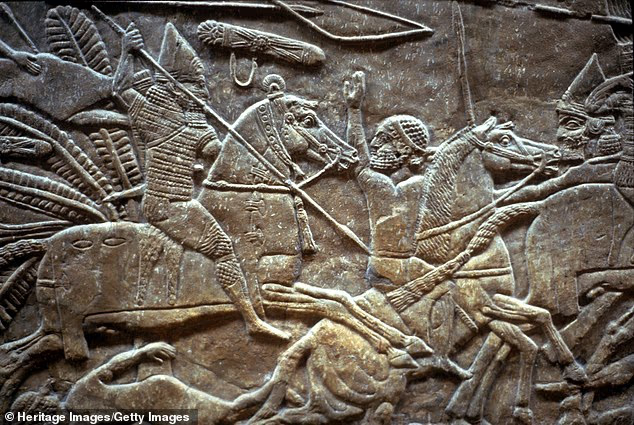
Warrior King: Ashurbanipal at the Battle of Til-Tuba, 650-620 BC
Smith was a self-taught translator, building on work done by eggheads earlier in the century who had cross-referenced the Assyrian tablets with bilingual dictionaries and relics found in other parts of the ancient Middle East. Sorting it out was like doing a giant three-dimensional crossword puzzle and, even today, many of the tablets still haven’t been fully decoded.
Selena Wisnom is one of only a handful of contemporary scholars who can read cuneiform, which is the name given to the ancient practice of making wedge-shaped marks on wet clay (cheaper than parchment and far more durable).
Wisnom’s special interest is the vast library collected by Ashurbanipal, king of the Neo-Assyrian Empire from 669 to 631BC.
It consists of 30,000 tablets which are packed with helpful information, from never trusting a man whose hair looks choppy on the left side of his parting (he will constantly be stealing from the king) to why getting peed on by an animal is a sign of good fortune. There’s also sensible advice on what to do when you encounter pigs dancing, cats talking and, oddest of all, bundles of reeds walking about in the countryside.
What quickly emerges is how much we still owe the Bronze Age Mesopotamians. Contained within these tablets are techniques for irrigating fields that still work today.
The practice of breaking an hour into 60 minutes starts here too. As does – a thousand years before he was born – the geometry theorem we now attribute to Pythagoras.

One of thousands: Cuneiform tablet relating part of the Epic of Gilgamesh, Neo-Assyrian, 7th century BC. A tablet from the library of the Assyrian King Ashurbanipal (reigned 669-631 BC).
Just like that early version of Noah’s Flood, here is evidence that sophisticated human knowledge reaches back further than anyone had previously believed possible.
It’s not all highfalutin. The tablets also show the Assyrians fretting about job security, falling out with their families, nurturing profound friendships and endlessly questioning the meaning of life.
One example of tricky family dynamics emerges in a tablet written by King Ashurbanipal’s sister to his young wife. Sherua-etirat ticks off Libbali-sharrat for her poor cuneiform script, which is big, wobbly and not up to scratch for someone in her exalted position.
To be fair to Libbali-sharrat, there is plenty of evidence that ordinary Assyrians found the whole business of making wedge-shaped marks with a stylus a bit of a palaver. Cuneiform signs are tiny – just 3mm high – and closely crammed together with no spaces between the words.
Wisnom has come across tablets written by schoolchildren who have clearly given up trying to make sense and instead have scraped off some clay with a grubby finger and started to play with it. Think of it as doodling, Mesopotamian-style.
Still, before we come away thinking that the Assyrians were just like us but with oddly optimistic beliefs about animal pee, it is worth heeding Selena Wisnom’s warning about the profound gulf that separates our two cultures.
The tablets are full of stories and spells that our forefathers took deadly seriously but which we might find . . . unconvincing.
So, for instance, if a man saw a snake on the first day of the year, it meant that he would be dead by the end of it. Luckily, though, there was an antidote: the unfortunate fellow had simply to gash his head and shave his cheeks. For the next three months he would feel miserable, but he would at least live.
Many of these odd omens and their cures concern food and feeding, hardly surprising given that Ancient Assyria was built on agriculture. So, for instance, the tablets say that a man with many facial moles will always have plenty to eat, even during a famine.

Bad Omen: Dr Selena Wisnom tries her hand at ‘extispicy’ and predicted Trump’s 2026 election win
However, a ruler whose wife has given birth to triplets should expect the imminent failure of the harvest (this seems particularly unfair, given how fertile the poor woman had proven herself to be).
War was a constant preoccupation too, although these omens were trickier to untangle. Priests were called upon to perform ‘extispicy’, which involved inspecting the entrails of slaughtered animals in order to interpret the gods’ will and get a fix on the future.
These entrails – sheep livers were popular – were checked by up to eleven diviners for tell-tale notches, blotches and ridges. And to ensure there was no collusion, a second or third team of entrail experts did an extra check without being told the initial results.
Wisnom points out that this system of ‘peer review’ is still the gold standard for scientists today. On one occasion, Ashurbanipal asked the diviners to work out whether the neighbouring Elamites would rise up against him. The results were ambiguous (you can’t help feeling that even the most scrupulous diviner might be tempted to second guess what the king wanted to hear).
In the end the Elamites did go to war with Assyrians and quickly rued the decision.

The Library of Ancient Wisdom is available now from the Mail Bookshop
Despite his deep love of the learning contained within his vast library, Ashurbanipal was first and foremost a military man. Wisnom points to some wall carvings from his palace, which are now held in the British Museum, along with the tablets.
One scene shows Ashurbanipal in the aftermath of victorious battle. He is relaxing in his garden while female servants ply him with sweet music and delicious snacks.
It all looks beautifully bucolic until you spot in a nearby tree a severed head – belonging to the Elamite king – casually dangling, like a Christmas ornament.
It is at moments like these we should probably thank our lucky stars (the Assyrians invented astrology too) that the past really is another country.

