Global stock markets surged and the oil price tumbled as investors breathed a sigh of relief over the ceasefire between the US and Iran.
The FTSE 100 closed up 2.5 per cent or 260 points at 10,609 – its biggest rally in a year – as the price of oil fell by as much as 17 per cent towards $90 a barrel.
The gains were echoed around the world with Wall Street opening sharply higher and the main benchmarks in Germany and France jumping 5 per cent and 4.5 per cent respectively.
Sentiment was boosted by the prospect that the Middle East could see an end to the conflict that has choked off energy supplies.
The price of a barrel of Brent crude, which has soared close to $120 a barrel during the war, saw one of its biggest one-day falls on record before partly recovering to around $95.
But analysts warned the truce between Washington and Tehran was fragile – with investors braced for fresh volatility in the days and weeks ahead.
Much of the focus remains fixed on the Strait of Hormuz – with Iran very much in control of the crucial waterway that before the crisis carried a fifth of the world’s oil and gas supplies.
Daniela Hathorn, senior market analyst at Capital.com, said: ‘The ceasefire should be viewed as a pause in escalation rather than a resolution.
‘The Strait remains the central lever in this conflict, and Iran’s willingness to reassert control suggests it is not prepared to relinquish that leverage easily.
‘Given the waterway accounts for roughly 20 per cent of global oil flows, even limited disruption is enough to reintroduce a significant risk premium into energy markets and keep volatility elevated.’
If you are reading on the This Is Money app, click here.
FTSE 100 up more than 300 points
The FTSE 100 is now up more than 300 points – rising as much as 3.3 per cent or 339 points to 10,687.
The rally leaves the blue chip index around 250 points off the all-time high of 10,934 reached the day before the Iran war erupted.
The gains are being echoed across Europe with the Dax up 5.3 per cent in Frankfurt and the Cac 40 up 4.9 per cent in Paris.
All eyes now on Wall Street…
Biggest oil price slump since Covid… but pain at the pumps goes on
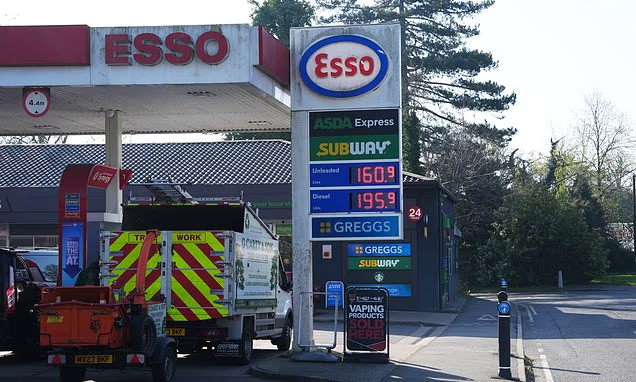
Drivers have been warned of further pain at the pumps despite some much-needed respite after the biggest fall in the price of oil since the Covid outbreak.
The price of crude tumbled as much as 16 per cent towards $91 a barrel on Wednesday morning after the US and Iran agreed a two-week ceasefire that will open the crucial Strait of Hormuz.
But while this will ease pressure on motorists at the pumps, those hoping for a sharp fall in the price of petrol and diesel look set to be disappointed.
Shell cashes in on Middle East conflict
Shell said it had seen a boost in oil trading in the first quarter as the conflict in the Middle East pushed prices higher.
But the FTSE 100-listed firm said it had slashed its gas production for the first quarter of the year after being affected by the conflict in the Middle East.
Shell’s shares are down over 5 per cent this morning as oil prices pulled back on news of the ceasefire.
Miners and housebuilders surge on ceasefire news
Miners Antofagasta and Fresnillo are among the FTSE’s biggest risers this morning as gold inched two per cent higher on news of the ceasefire.
Housebuilders are also gaining as traders slash the chances of the Bank of England hiking interest rates.
Persimmon is up 8.64 per cent, while Barratt Redrow and Berkeley are up 8.6 per cent and 6.6 per cent, respectively.
Close Brothers’ shares surge on motor finance update
Close Brothers shares surged this morning after posting an update on the motor finance redress scheme announced by the City watchdog last week.
The banking group expects the Financial Conduct Authority’s redress scheme to cost it in the region of £320 million, which it said was ‘broadly similar’ to what it expected. It added that it could be ‘comfortably absorbed by existing capital resources.’
‘Steep hurdles to clear’
Chris Beauchamp, chief analyst at IG said: ‘Both sides will spin this as a win, but for investors the important thing now is whether the negotiations that begin this week will lead to a durable deal.
There are some pretty steep hurdles to clear, on uranium, missiles and who controls the Straits of Hormuz, so we could be poised to repeat Tuesday’s drama some time in the second half of April.
‘But for now stocks have the bit between their teeth and oil prices have fallen back below the totemic $100 level. Disruptions are bound to follow across the globe but progress on a sustainable deal might mean that markets might continue to look past these, just as they did with tariff uncertainty.’
FTSE surges and gilt yields slide
The FTSE 100 is up 280 basis points yo 10,632 as investors breathed a sigh of relief following news of the ceasefire.
L&G, Prudential and Howden Joinery all rose by over 5 per cent.
Gilt yields were on the slide as markets slashed their bets on Bank of England interest rate hikes this year.
The 5 year gilt yield, which moves inversely to price, fell 22 basis points to 4.238 per cent, while the 10-year yield dropped 19 basis points to 4.71 per cent.
Markets are now pricing in a 35 basis point hike this year – between one and two 25bps – compared to 63bps on Friday.
House prices slide on Middle East uncertainty
The average house price fell 0.5 per cent in March, following a 0.3 per cent in February, according to the latest Halifax house price index.
It meant that across the UK, the average house price was £299,677 last month.
Growth in property values also slowed, reaching 0.8 per cent, down from 1.2 per cent in February.
Amanda Bryden, head of mortgages, Halifax, said: ‘The recent slowdown in the housing market reflects the wide uncertainty regarding the conflict in the Middle East.
‘Concerns about higher energy prices have pushed up inflation expectations, which in turn led to a rise in mortgage rates, reducing confidence that interest rates will be cut this year and dampening the initial momentum in the market seen at the start of the year.’
Share or comment on this article:
FTSE 100 gains 260 points as oil crashes towards $90 – MARKETS CLOSE