

When Terence Stamp went on about his childhood in Stepney, or if Michael Caine ever mentions his humble origins down the Elephant and Castle, it should be noted that, compared with Charlie Chaplin, who really did endure ‘desperate need’ at the end of the Victorian era in south London, their backgrounds, scarcely half a century later, are positively luxurious.
This book is about the documentary reality behind Chaplin’s later comic vision; the origin of his tramps, waifs, abandoned babies. Today, with the welfare state taken for granted, it is hard for most to imagine such an insecure existence, ‘not knowing where the next meal would be coming from’, and with constant threats of eviction and homelessness.
Jacqueline Riding evokes late 19th-century London with an artist’s eye – the rooming houses and shabby apartments with bird cages in the windows, the yards for drying laundry and dumping domestic waste. Londoners grew up never seeing green grass ‘or smelling the sweet breath of the country’.

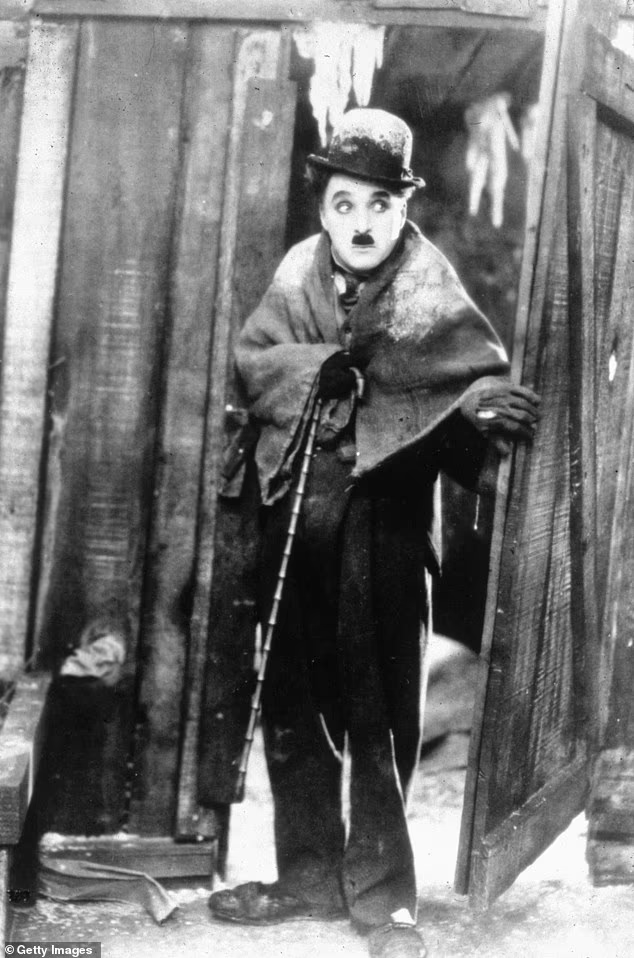
Little Tramp: Chaplin in one of his most famous roles
Poor health was endemic – rickets, rheumatism, odd gaits – as there was little access to doctors. Sanitation was poor, cholera and typhoid outbreaks common. Limbs broken in industrial accidents received poor treatment. Infant mortality was sky-high.
There was a constant hubbub, with people keeping pigs and geese. The district was thronged with artisans, labourers and servants; weavers, rope-makers and shoemakers. Chaplin’s maternal grandparents were cobblers – possibly descended from Irish gypsies. They also sold old clothes from a cart in the streets.
Illegitimacy was common, as was the fear of being jilted. If husbands failed to be breadwinners, women left without financial support ended up in the workhouse, as happened in Chaplin’s mother’s case.
Born in 1865, Hannah was a singer in the music halls, where she met Charles Spencer Chaplin Senior. ‘Only a year after my birth, in 1889, my parents separated,’ stated the future comedian.
Chaplin Senior was dead at the age of 37 from alcoholism. Six raw eggs whisked in a pint of port was his staple.
Hannah found the worry of her own stressful and unpredictable life too much to bear and collapsed during a performance.
‘She would lie for days in a darkened room,’ recalled her son. Along with Charlie and his brother Syd, Hannah was sent to the Lambeth Infirmary and Workhouse, where on top of everything else there was an epidemic of ringworm. An earlier patient was Polly Nichols, murdered in Whitechapel by Jack the Ripper.

Making the best of things: A group of boys in ragged clothing play a game of marbles in the back yard, c. 1860
Riding gives us harrowing details of the workhouse system, prisons by another name, which were deliberately made ‘as unpleasant a place and experience as possible’.
The inmates were kept in damp conditions, deficient in ventilation. Sexes were segregated, families separated. ‘Husbands and wives were kept apart by a high wall and jagged shards of glass.’ Dead bodies were sold for ten shillings to Guy’s Hospital for dissection lectures.

Making a star: Charlie Chaplin’s desperate upbringing stirred a desire to be on the stage
Charlie and Syd were transferred to the Hanwell School for Pauper Children. When he was handed a script at the age of 12, Charlie ‘had difficulty reading it’, his education had been so piecemeal.
But this is how it was for the working class. If children went to school, it removed them from the labour market, exacerbating poverty. It’s horrible to learn they were beaten to make them go up chimneys, and how prevalent casual violence was ‘among the working class’.
Hannah continued to go in and out of institutions. At the Cane Hill Lunatic Asylum, it was decided ‘her mind was undoubtedly impaired by malnutrition’.
Meanwhile, Charlie was pretty much on the streets, an urchin living by his wits, as an errand boy in a chandler’s shop, a glass blower, a shop boy in WH Smith, and a laundry delivery boy.
Nevertheless, always there was in his demeanour ‘something that was unbroken, something single-minded, intense, much bigger than his small, wiry body’.
H e found he loved the entertainment he heard and saw coming from the many pubs – singers and dancers, humorous sketches, fire-eating, dog acts. It was in these hurdy-gurdy street sounds and marching bands that ‘I first discovered music,’ Charlie said.
By 1898, he was clog dancing with Stanley Jefferson, who’d later change his name to Stan Laurel. Charlie joined Fred Karno’s troupe in 1908, the clowning ‘cruel and boisterous, filled with acrobatic humour and low, knockabout comedy’.
Charlie found regular work as a pageboy in a West End production of Sherlock Holmes. ‘I realised I had crossed an important threshold. No longer was I a nondescript of the slums; now I was a personage of the theatre.’
Charlie went with Karno to America in 1912, and never lived in England again. What Hard Streets makes abundantly and fascinatingly clear, however, is that England was never for a moment shaken off.
Thinking of his background, the pavements with the litter of discarded coloured tram tickets, the shouts of the costermongers, the press of the crowds and the grinding poverty, Charlie admitted later that ‘from such trivia I believe my soul was born’.
The uncleanliness and despair –this is like we saw in his films The Kid or City Lights, with women ‘whose only sin was motherhood’; the flower girls and blind maidens, who are actually prostitutes.
All the authority figures Charlie encountered, charity and parish officials, local councils, health inspectors, truancy officers, police constables – these are the pompous figures of fun, outwitted in dozens of silent films by the Little Tramp, Chaplin’s most memorable on-screen character.
With his dented bowler hat, threadbare clothes and bendy walking stick, the Little Tramp was (and remains) the classic symbol of resilience and resistance.
Charlie Chaplin, as Riding says without exaggeration, was ‘one of the most famous human beings on the planet’, exchanging a blighted beginning for untold wealth and status.
He died in Switzerland on Christmas Day 1977, having been knighted (belatedly) two years earlier.
His genius was to turn the tragedy of reality into comedy on the screen, and he accomplished this feat because ‘whether life is tragedy or comedy depends on how you look at it. There is not a hair’s breadth between them’.
Charlie had had no encouragement from his mother, by the way. ‘You’ll finish up in the gutter like your father,’ Hannah predicted. She was wrong about that.
In 1921, rich and world famous, he paid for her to come and be with him in America, where she died seven years later. She is buried in Hollywood.

