

- How Flowers Made Our World by David George Haskell (Torva £22, 352pp)
Walk round a natural history museum and you will find that the story of our planet is narrated through displays of fossils, dinosaur bones, primates, birds and butterflies.
Flowering plants? They barely get a look in.

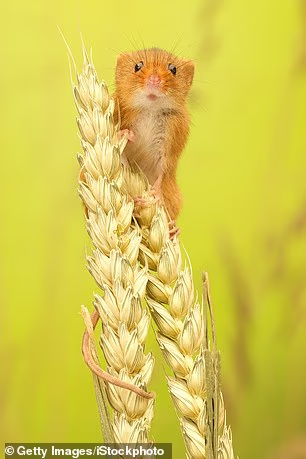
Harvest mouse clubbing on some wheat
In this eye-opening book, biologist David George Haskell argues that this ‘zoocentric’ approach is deeply flawed. Flowers are not just pretty – they are also revolutionaries that overturned the old order of things and thus provided the building blocks for the world we live in.
Flowers were relatively late arrivals, appearing about 200 million years ago, long after the evolution of vertebrates, insects and crustaceans. Once they burst onto the scene, flowering plants were the catalyst for the evolution and diversification of many animals.
Bees, which pollinate so many of our fruits and vegetables, evolved from wasps 120 million year ago because they started feeding on floral pollen and nectar. Brightly-coloured butterflies evolved from moths in response to this new floral abundance.
Other insects such as beetles, wasps and flies existed long before flowers, but became much more diverse once blooms took over the planet.
The pre-flowering world was all sludgy browns, greens and greys, and would have smelled strongly of leaves, mushrooms and mud. Flowering plants brought colour and scent to the landscape, but their real superpower was to draw different species together into productive partnerships.
They wove together the below-ground world of soil microbes and fungi with the above-ground world of pollinating insects and fruit-dispersing birds.

How Flowers Made Our World is available now from the Mail Bookshop
It’s hard to imagine just how different a world without flowers would be: ‘Take away the flowers’ relationships with animals, and almost all modern animals and most ecosystems would disappear,’ writes Haskell.
You might not think of grasses as flowering plants, but they do, in fact, carry clusters of small flowers along their stalks. Grasses, mostly rice, maize and wheat, supply us with two thirds of our calories, as well as providing much of the food for livestock.
Without grasses, we humans would still be small-brained apes living in trees, feeding on forest fruits, leaves and animal prey.
In showing how flowers have built and sustained ecosystems, from rainforests to prairies, Haskell delves into the ancient history of magnolias, considers why orchids are ‘sexually deceptive’, and stresses the importance of coastal plants like seagrass, which lock up carbon far more effectively than woodlands or rainforests.
He is a lively writer with an appealingly light touch, but his message about ‘the astonishing creativity and productivity of flowers’ is a serious one.
Flowers are vital to our survival and their habitats need to be cherished and protected.

