

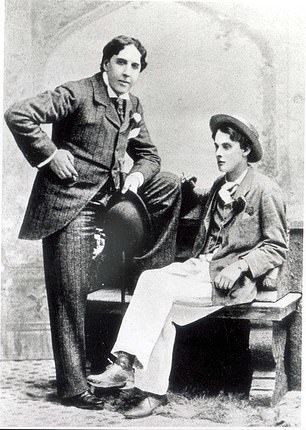
A century or more after the Oscar Wilde scandals and disgrace, everything has finally come right. There’s a commemorative window in Westminster Abbey, a statue by Maggi Hambling near Charing Cross (except souvenir hunters keep sawing bits off) and The Importance Of Being Earnest is running in the West End starring Stephen Fry as Lady Bracknell.

Oscar Wilde and his lover ‘Bosie’ Lord Alfred Douglas
Wilde’s plays have been performed in Hindi and Arabic. Translations, often unauthorised by the estate, have appeared in Turkey, Latvia, Greece and Portugal.
Wilde’s tomb in Pere Lachaise cemetery, Paris, sculpted by Jacob Epstein, is a place of pilgrimage. The monument has been so smothered with lipstick kisses and well-meaning graffiti, the porous stone started to crumble – so glass protective screens were erected. Once upon a time, the statue of a flying angel- demon, which surmounts the grave, displayed ‘prominent testicles’. They have long since vanished, and are no doubt in use as paperweights.
Wilde’s rehabilitation has taken a lot of time and effort, and Merlin Holland, his grandson, contemplating all the ‘unwept family grief’, dubs the saga ‘the longest continuous act of hypocrisy in British history’.
One moment Wilde was the Victorian era’s most brilliant dramatist, the next he was a ‘loathsome importer of exotic vice’, spending two years in solitary confinement for homosexuality. Released from prison in 1897, as a ‘perverted ex-convict’ he was the victim of a strict moral code. Wilde was compelled to separate from his wife, Constance, and his children, Cyril and Vyvyan, were taken from him by court order.
Alone in exile, ‘the joy of life is gone’, Wilde lamented. ‘The morgue yawns for me.’ Though there were rumours he was hiding in a Spanish monastery, Wilde died in Paris in November 1900, aged 46. His name was removed from the roll of honour at his place of education, the ‘vehemently narrow-minded’ Portora School in Enniskillen. Constance’s grave in Genoa had ‘wife of Oscar Wilde’ added to the stone only in 1963.
The children were dissociated from any connection with Wilde. They were shown no kindness by anybody, such was ‘the disgust for Oscar’.

Merlin Holland outside the tomb of his grandfather
Their surname was changed to Holland. Cyril, who grew up to be ‘pompous and intolerant’, followed a military career. As his father’s name remained on his birth certificate, however, he was held back from promotion. Nevertheless, he served with distinction in the Royal Field Artillery and was killed in action in 1915.
Vyvyan, Merlin’s father, died in 1967, having fallen down the stairs in his London club. He was a wine journalist and author, who always managed to be hard-up. Indeed, he was bankrupted after failing to pay back-taxes on royalties. He survived from day to day by selling off Wilde first editions.
Also relinquished was a pair of silver wine jugs, engraved with presentation inscriptions to Sir William Wilde, Oscar’s illustrious father, ‘an extraordinary polymath’ and an important figure in the history of Irish medicine, who received a knighthood for being Queen Victoria’s oculist. Despite his best efforts, Merlin has failed to track the jugs down.
Thelma, Vyvyan’s wife, an Australian prone to ‘colonial snobbishness’, turned into ‘a tiresome literary widow’. Believing that outspokenness about Wilde would ‘only handicap’ Merlin’s life, she did her best to whitewash the story. She tore pages out of diaries, suppressed documents and memorabilia, and was determined the Holland/Wilde family ‘should be seen as squeaky clean and sexless’.
She told her fellow Melburnian Barry Humphries that Oscar was very definitely ‘not one of them’. Thelma’s other activity was as Elizabeth II’s cosmetics consultant, and she did Her Majesty’s make-up for the Coronation in 1953.
The person in most ferocious denial, however, was Oscar’s former lover, Lord Alfred ‘Bosie’ Douglas, who initiated Wilde into the underground of male brothels. However, he would become the playwright’s nemesis. Bosie precipitated the trials of 1895 when he urged Wilde to sue for libel after his outraged father, the Marquess of Queensberry, felt bound to accuse Wilde of homosexual vices, or ‘the love that dare not speak its name’. It spoke its name loudly enough for Wilde to be charged with gross indecency.
Bosie fled to France, was never charged over his own involvement with rent boys, and in 1911 became a Catholic, turning himself into ‘a respectable country gentleman’, unleashing lawyers on anyone who attempted to link him with Oscar. And it took only ‘the slightest hint of a disparaging remark’ for his ‘quarrelsome temperament to tip into belligerence and litigation’.
The original manuscript of Wilde’s angry letter to him from prison, De Profundis, had been placed by Robbie Ross, Wilde’s executor, in the British Museum for safekeeping. Bosie never recovered from the knowledge that the document exposed the realities of his reckless and cruel behaviour.
In 1914 Bosie published a memoir claiming he was unaware of Wilde’s proclivities. ‘I think,’ he said, with inadvertent comic hyperbole, ‘that Wilde had a diabolical influence on everyone he met. I think he is the greatest force for evil that has appeared in Europe during the last 350 years.’
Bosie died in 1945, making legal threats until the last. His contempt and revulsion, however, did reflect the prevailing mood.
In 1953, for example, there were moves to place a blue plaque on the Wilde home in Tite Street, Chelsea. It proved hard to find a celebrity to unveil it. T.S. Eliot turned the committee down, as did Laurence Olivier, Bertrand Russell and E.M. Forster.
Future Poet Laureate Cecil Day-Lewis, father of Daniel Day-Lewis, refused to come up with a celebratory verse. Joyce Grenfell didn’t want to attend the ceremony, perhaps thinking, as a magistrate did in Worcester, that it was ‘a disgraceful public spectacle’.
As Merlin says, 72 years later, ‘it is unthinkable that such comments could be made publicly’. Yet they were, repeatedly. Until well into the Sixties and Seventies, politicians were calling homosexuality ‘a filthy, disgusting and unnatural vice’.
When the House of Lords was still filled with hereditary peers, the only subjects that got them going were homosexuality and badgers – but then I don’t suppose there were many badgers sitting in the House of Lords. At Eton, Merlin was told, ‘Your grandfather was nothing but an old poofter.’
Permissiveness has brought its own problems, of course. With Wilde gradually fashionable and acceptable again, the market has been flooded with forged manuscripts. ‘Potential customers would tend to let excitement overcome caution.’ One much-vaunted treasure was concocted on paper that wasn’t available until 14 years after Wilde’s death.
Biographies have been a minefield of erroneous and sensational data, creaking with ‘mistaken memories and fabricated anecdotes’, eg about Wilde in places he never visited, encountering people he never met, complete with invented quotations. Particularly egregious is a book by Richard Ellmann, who stated Wilde died of syphilis, caught from a (female) prostitute at Oxford. The plate section is also nonsense. Wilde in drag as Salome is actually a Hungarian opera singer called Alice Guszalewicz.
After Oscar is a magnificent gallop across a cultural and social landscape, where we see fashions changing, prejudices coming and going – and maybe coming back. Will the Me Too movement catch up with Wilde and cancel him again, I wonder?
Though his image – cloak, fedora, green carnation – adorns and endorses sparkling wine, hotel suites, a Norwegian aeroplane and an Irish ferry, and though his aphorisms (‘We are all in the gutter, but some of us are looking at the stars’) are on a billion greetings cards, how quickly the wind can change when the neo-puritans take over. Jane Austen, I’m told, is doomed, because her world was sustained by slavery.

