

MUV: The STORY OF THE MITFORD GIRLS’ MOTHER by Rachel Trethewey (History Press £22.99, 272pp)
Picture this scene in the lobby of the Grand Hotel in Nuremberg in September 1938. Lord and Lady Redesdale, parents of the Mitford girls, were visiting the city as Hitler’s guests of honour at the Nuremberg Rally.
They looked like a couple of characters from a P. G. Wodehouse novel.
In a corner of the lobby on the morning of the rally, Lady Redesdale was passing the time doing her embroidery. She lost her needle.
Her husband got down on his hands and knees to search for it, while jackbooted stormtroopers and SS men marched past them in all directions.
That sums up the character of ‘Muv’, as Lady Redesdale was known by their children.
On the one hand, she was a zealous convert to Nazism – almost as ardent as her Hitler-worshipping daughter Unity. On the other hand, she was a British aristocratic wife and mother, who did embroidery to pass the time – and had clearly trained her doting husband to search on the floor for her mislaid needles.
How could a sensible, devoted British mother of seven be so taken in by Nazi propaganda?
Muv’s chief flaw, writes Rachel Trethewey in her clear-eyed portrait of the woman whose lot it was to be the mother of the rebellious Mitford daughters, was her refusal to face anything politically unpleasant, such as the truth about what Hitler was really up to. Her husband (known as ‘Farve’) was equally blinkered throughout the 1930s.
In a letter to The Times, he described Hitler as ‘a right-thinking man of irreproachable sincerity and honesty’.
But when war broke out, Farve did a massive volte-face, turning fiercely against Nazism. Muv did not.
‘She refused to stop admiring Hitler,’ Trethewey writes. ‘It was the biggest act of defiance of her life.’ In this, ‘she was as big a rebel as any of her daughters’.
She assured her family that ‘when the Germans had won, everything would be wonderful, and they’d treat the British much better than those wretched, beastly Poles.’

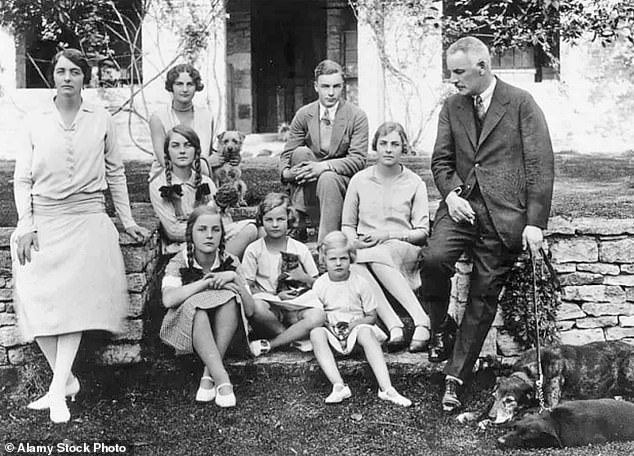
Family Unit: Lord (right) and Lady (left) Redesdale with their children

Pre war: Unity Mitford, Lady Redesdale and Joan Villiers at an RAF pageant in 1932
After Unity shot herself in the head with a mother-of-pearl pistol, in horror at the outbreak of war between the two countries she loved, and remained incontinent and with a mental age of 11 till her death nearly nine years later, Muv devoted her life to looking after her, never swerving from her fascist convictions.
Her marriage came under increasing strain, leading to eventual separation.
What caused this obstinacy? Born Sydney Bowles in 1880, Muv’s own mother died when she was seven, during childbirth. She was brought up by her anti-Semitic father Thomas, a Conservative MP who ‘had no patience with toleration’, believing politics should be defined in black and white, not in shades of grey. That hard-line stance was inherited by his daughter.
Her father was anti-medicine, never allowing Sydney to see a doctor. This, too, he passed on to Sydney, so when she had her children – Nancy, Pamela, Tom, Diana, Unity, Jessica and Deborah (a gruelling string of pregnancies from the age of 24 to 40) – she too took no notice of their illnesses, telling them ‘the good body will heal itself’.
They arrived at children’s parties hacking with whooping cough or covered in chickenpox and measles spots.
Muv also believed in the medical benefits of wholemeal bread, claiming to be ‘the only peeress who has made all the bread for her family for years’. When she first met Hitler for tea in the Carlton Tea Rooms in Munich in 1937, she raised her favourite topic: ‘Did Germany have any laws to guarantee the use of wholemeal flour?’
In some ways Muv was quite progressive as a mother. A conscientious keeper of family accounts, she trained her children to keep pigs, hens and calves. They had to pay a farming ‘rent’ to their father but were allowed to keep the profits.
Sydney herself kept 500 hens and sold the eggs to London to pay for the children’s education, some of it by ‘inept governesses’ (as her acerbic daughter Nancy later put it).
Muv needed that extra money, because her husband David Mitford (who inherited the Redesdale title on the death of his elder brother) was useless as a businessman.
He went prospecting for gold in Ontario, Canada, but the plot he bought yielded minimal traces. Unity was conceived during that time, in a town aptly named Swastika.

Defiant: (Clockwise from top left) Unity, Jessica, Diana and Nancy
In other ways, Muv was hopelessly out of touch with the times, driving her children mad with frustration. When Jessica said she wanted to go to grammar school and become a scientist, Muv said, ‘A scientist! What nonsense! No, of course you can’t go to grammar school.’
Jessica said that refusal ‘burned into my soul’. Instead of becoming a scientist, she became a communist, eloping to Spain with her lover Esmond Romilly, causing untold anguish to her parents who didn’t know where she was.
It’s not unusual for parents to be torn between the different inclinations of their children, but Muv surely wins the prize in this regard, with one daughter an ardent communist and another an ardent fascist.
After the war, Jessica refused to go to dinner with her sister Diana, saying she would not eat with ‘murderers’. Muv tried to keep the peace between her warring children.
When Diana, who was married to fascist leader Sir Oswald Mosley, was in jail in Holloway Prison for three years from 1940 to 1943, Muv visited her there every week. The bus driver announced, ‘Holloway Gaol! Lady Mosley’s suite!’ Everything the Mitfords did was done in the public eye.
The two terrible losses of Muv’s life were that of Unity, and of her only son Tom, who was shot by a Japanese sniper in Burma in 1945 and died aged 36.
Muv’s granddaughter Charlotte Mosley said: ‘You could never underestimate the blow of Tom’s death. What Sydney went through during the war . . . most of us would be flattened.’
Charlotte explains her grandmother’s politics thus: ‘She was passionately anti-communist; that was why she took the other side. At that time, there was only one camp or the other.’

Lady Redesdale with Unity and Dr Fritz-Randolph at a Christmas Party given by the Anglo-German Fellowship at Victoria Hall in Bloomsbury, London
Jessica did not let her off so easily. She said Muv was shown a copy of The Brown Book Of The Hitler Terror, which contained graphic photographs of the brutal persecution of the Jews by Hitler’s stormtroopers. ‘People say they didn’t know what was happening to the Jews till after the war, but they did know, because it was all there.’
In her final years living at Inch Kenneth, their island in the Inner Hebrides, Muv kept old 78rpm records of Nazi songs in the drawing room, plus Wagner’s Ring Cycle – a set of records given to her by her old friend Adolf Hitler.

