


They are among the ocean’s most feared predators – and now a new video shows why orcas live up to their ‘killer’ reputation.
A heartbreaking video shows a pod of orcas hunting a humpback whale calf in the Sea of Cortés off the coast of California.
The orcas drag the struggling calf away from its mother and drown it by forcing it beneath the waves before it has a chance to breathe.
Photographer Carlos Guana, who captured the incident using a drone, described the scene as ‘a reminder that nature is brutal every day’.
Mr Guana spotted the humpback mother and her calf as they were travelling north from their calving grounds in Mexico‘s warm waters, towards the feeding grounds of Alaska.
Even though a newborn humpback calf can be 13 to 16 feet (4–5 metres) long and weigh a tonne or more, they are an easy source of food for nature’s most deadly hunters.
Led by their matriarch, the orcas surrounded the calf and took turns slamming into the calf, pummelling it and pinning it down until it was too exhausted to fight back.
Finally, in a moment which Mr Guana described as ‘cruel and deliberate’, the orcas brought the dead calf back to the surface and appeared to show the body to its mother before swimming away to feed.

Drone footage has captured the heartbreaking moment a pod of orca drowned a humpback whale calf in the Sea of Cortés off the coast of California

Orcas, known as killer whales, are some of the ocean’s most intelligent and effective hunters. Some populations have learned to prey on whale calves as they travel from their calving grounds
Although orca attacks on humpback whales are relatively rare, scientists have found that they are much more common than you may expect.
‘I don’t believe it’s rare that it happens,’ says Mr Guana.
‘Any whale watcher will tell you they often see what I call rake marks on the tails of humpbacks.
‘Those long scratch–like marks mean orcas have attacked them or engaged with them using their teeth.’
Studies have found that, as humpback whale numbers have stabilised following the end of whaling, the number of orca attacks has increased.
This is especially true along humpback whales’ migratory routes, where weaning calves present an easy and abundant source of food.
In these areas, some groups of whales appear to have specialised as whale hunters, developing hunting techniques for targeting calves.
One study of orca attacks off Western Australia found that three orca pods killed at least 14 humpback calves in 22 separate attacks.

The orcas took it in turns to ram the humpback calf, pinning it under the water until it was too exhausted to fight back to the surface

Eventually, the humpback whale lost the energy to fight back and was pulled beneath the surface of the water, where it drowned

Although a humpback whale calves can weigh more than a tonne, they are easy prey for orcas, which hunt in highly coordinated packs
One killer whale tagged by researchers led her pod to attack eight humpback calves in just 20 hours, killing at least three.
The orcas in the attack filmed by Mr Guana are part of the Eastern Tropical Pacific, or ETP, population – a group known for taking on the biggest prey.
Mr Guana says: ‘These particular orcas eat large marine mammals, sharks, even whale sharks – big things.’
At times when food is exceptionally abundant, orcas are also known to be selective eaters.
In some cases, certain populations of orcas have been known to be so fussy that they will only eat the breast meat from penguins they kill.
‘They attacked and drowned the humpback, then basically just ate the tongue and left the rest of the whale there,’ said Mr Guana.
This matches what previous studies have found, which found that orcas will often eat only the neck, tongue, lips, and ventral flaps of humpback calves.
Mr Guana says that the body soon attracted sharks, and other scavengers soon set upon the body.

Studies have shown that orcas will eat only the neck, tongue, and lips from humpback whale calves, leaving the rest for other scavengers

Whale carcasses, known as whale falls, provide a vital injection of nutrients into deep–sea ecosystems. The bones of a whale can support life at the bottom of the ocean for years to come
While it might be upsetting, this hunting behaviour is also important for orcas to be able to support their own young and to teach them the skills they need to survive.
Without a reliable source of prey, the orca’s young would not grow fast enough to survive on their own.
Mr Guana says: ‘This scene, one of the most conflicted moments I’ve witnessed in nature, was extraordinary to witness.
‘While this matriarch fed her young ones with this, and the carcass provided food to the sharks and other creatures that showed up, it was a reminder that nature is brutal every day.’
The carcasses of dead whales will eventually drift down to the ocean floor in an event known as a ‘whale fall’.
The body will trigger a bloom of life as scavengers from all around are drawn in by the smell.
Even the whale’s bones will support the local ecosystem for years to come as a place for invertebrates to colonise and as a source of energy for microbes.
‘The price of a healthy ecosystem is the brutal moments that exist within. I captured the complete kill,’ says Mr Guana.
HUMPBACK WHALE POPULATIONS AND THEIR THREATS
Humpback whales live in oceans around the world. They travel incredible distances every year and have one of the longest migrations of any mammal on the planet.
Some populations swim 5,000 miles from tropical breeding grounds to colder, plentiful feeding grounds – this is why it is difficult to estimate population size, according to the National Oceanic and Atmospheric Administration (NOAA).
Of the 14 distinct populations, 12 are estimated to number more than 2,000 humpback whales each and two are estimated to number fewer than 2,000.
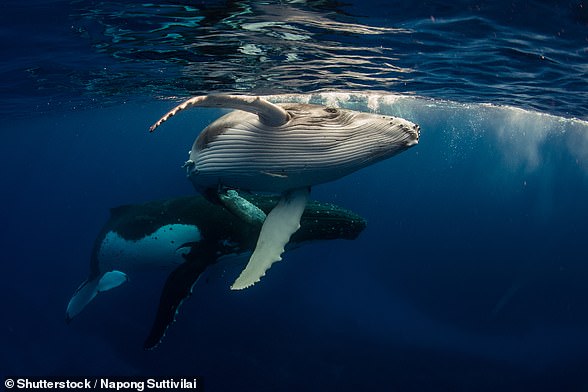
Humpback whales live in oceans around the world. They travel incredible distances every year and have one of the longest migrations of any mammal on the planet
Some populations (such as those off eastern and western Australia) are believed to number in excess of 20,000 animals—a remarkable recovery given that the same populations were almost eradicated by whaling almost sixty years ago.
By contrast, the smallest known population is one which inhabits the Arabian Sea year-round, and may number as few as 80 individuals.
Threats to humpback whales include decline in food like Krill due to a combination of climate change and industrial-scale fishing.
Humpback whales can become entangled by many different gear types including moorings, traps, pots, or gillnets.
Once entangled, if they are able to move the gear, the whale may drag and swim with attached gear for long distances, ultimately resulting in fatigue, compromised feeding ability, or severe injury.
There is evidence to suggest that most humpback whales experience entanglement over the course of their lives, but are often able to shed the gear on their own.
Inadvertent vessel strikes can injure or kill humpback whales.
Humpback whales are vulnerable to vessel strikes throughout their range, but the risk is much higher in some coastal areas with heavy ship traffic.
Underwater noise threatens whale populations, interrupting their normal behaviour and driving them away from areas important to their survival.
Sound has been shown to increase stress hormones in their system and mask the natural sounds humpback whales require to communicate and locate prey.

