

The Meteorite Hunters by Joshua Howgego (Oneworld £18.99, 272pp)
In December 1795, ploughman John Shipley was working in a field in the Yorkshire village of Wold Newton when he heard a series of loud explosions above him.
As he looked up, he saw something fall from the sky, spitting out fire, and plunge into the ground a few feet from him. He supposedly told people that he thought heaven and Earth were somehow coming together.
What he had experienced was the fall of a meteorite.
As Joshua Howgego explains in this richly informative, readable book, the Wold Newton meteorite marked a turning point in the story of how we came to accept that stones from space sometimes just fall from the sky.
Put on display in London’s Piccadilly, it briefly became the talk of the town and the era’s scientists sat up and paid attention.
Meteorites had, of course, been noted before. The ancient Greeks wrote of stones falling from the sky. An iron dagger found in Tutankhamun’s tomb was, recent research shows, fashioned from a meteorite. A hieroglyph used in the pharaoh’s time can be roughly translated as ‘iron from the sky’.
What exactly are meteorites? They are rocks that originate elsewhere in the solar system but plummet through the Earth’s atmosphere and into the ground. Many start life as part of an asteroid, although one found in the Sahara in 2011 turned out to be a small bit of Mars.
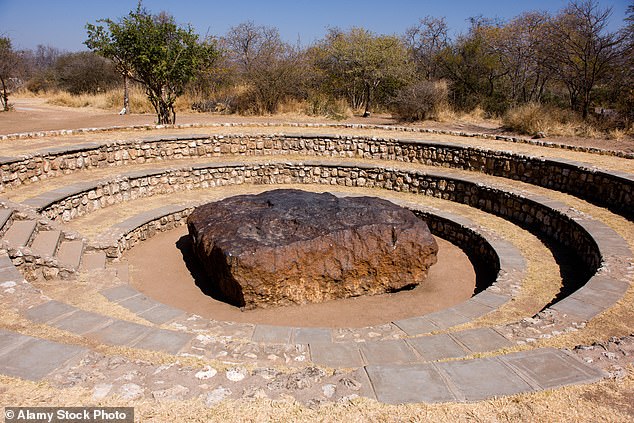
They come in a variety of sizes. The biggest is the Hoba meteorite in Namibia, which is nearly 9ft long and weighs 60 tons.

Out of this world: The Hoba meteorite in Namibia weighs 60 tons
During the First World War an Army captain named Gaston Ripert in the then French colony of Mauritania reported that he had come across a meteorite in the desert that was gigantic, many orders of magnitude larger than the Hoba.
According to Ripert, it was 40m high and 100m long. Unfortunately, nobody has ever been able to find it again. Known as the Fer de Dieu (Iron of God) it remains the Holy Grail of meteorite hunters.
Some meteorites do not need much hunting. In 2019, pieces of one rained down on a village in Costa Rica. A chunk smashed into a kennel housing an alsatian dog whose name, by a happy coincidence, was Rocky. (Rocky survived and his home, complete with a meteorite-shaped hole, later sold at auction for £35,000.)

Sky fall: A meteor shower
Has anyone ever been killed by a meteorite? Possibly not, but there have been some near misses. In Alabama in 1954, a woman named Ann Hodges was taking a nap on her sofa when a meteorite crashed through the roof and struck her on the thigh. She suffered no worse than a nasty bruise.
Ann had no need (or indeed wish) to seek out her meteorite, but Joshua Howgego meets plenty of people who actively hunt for them.
One man from Arizona tells of how he was arrested and briefly imprisoned as a spy in Oman by soldiers who didn’t believe his story that he was just hunting for meteorites.
Another, a one-time Norwegian jazz guitarist, takes Howgego on a perilous journey by ladder to the top of a four-storey building in search of micrometeorites – specks of space dust that fall to Earth.
It’s not difficult to appreciate the lure of tracking down meteorites. ‘There is something inside me that makes me want to find rare things,’ one hunter remarks. As Howgego points out, all meteorites have stories to tell. ‘When we clutch a meteorite,’ he writes, ‘we hold the history of the solar system in our hands’.
His book is full of these stories.

